| |
In a Crisis - How Parents can help
Parents are the primary resource in helping children recover from a crisis. Schools may meet with families in small groups, provide information and serve as resources for sharing concerns and for mutual support. Some parents, however, may need individual help before they are ready to meet the needs of their children.
|
 |
Your child needs you
When you have experienced a crisis, family routines are disrupted. You have much to do, particularly if your children are quite you. It is hard for young children to understand what has happened. Some may have completely mixed-up views of the situation, while others, depending on age and maturity may need continuous guidance and understanding if their are to grow through their experience.
Children may experience the some intense feelings. Some may show their feelings in a direct and immediate fashion, while others will wait until long after the crisis. Most will be confused by all the sudden interruption to their routines. This is a very difficult time for them as well as you. Each child in a family may react differently. You will find listed below some ways you may help children in coping with their feelings following a crisis:
Following a crisis, some children may:
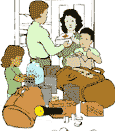 |
• become more active and restless.
• If homes have been damaged, they may worry where they will five and what will happen to diem.
• Become upset easily, crying and whining.
• Be quiet and withdrawn, not wanting to talk about the experience. |
• Feel neglected parents who are busy trying to clean up and rebuild.
• Become afraid of loud noises, rain and storms.
• Be angry. They may hit, throw, kick or find other ways to demonstrate their anger.
• Be afraid to be left alone or afraid to steep alone.
• Have symptoms of illness such as nausea, and/or headaches. They may have eating problems.
• Be upset at the loss of favorite toys or blankets.
• Feel responsibility for causing the disaster, perhaps attributing it to some previous misbehavior.
• Refuse to go to school or child care arrangements.
• Fear recurrence.
Links
Disasters - Fact or Fiction FEMA site explains many natural disasters and offers suggestions for how to prepare and how to cope with them. A portion of this site is devoted to children and provides a variety of activities to increase understandiing and coping skills. |
Ways parents can help their children
• Talk with your children providing accurate information to questions. Allow them to tell their stories and share their feelings. You child may ask the same questions repeatedly. Be patient and reassuring.
• Share with children your own feelings .
• Listen to what your children say and how they say it. Repeat your children words, recognizing fear, anxiety, and insecurity. For instance: "You are afraid that . . " "You wonder if it will happen again today."
• Reassure your child: "We are together." "We care about you."
"We will take care of you."
• Hold your child, providing comfort. Touching is vital for
youngsters during this time.
• Spend extra time at bed time. Leave a night light on.
• Observe your child's play. Listen to what is said. Frequently, youngsters express feelings of fear or anger while playing with dolls, trucks and friends.
• Provide tension relieving experiences. For young children, use playdough, paint, and crayons to express feelings. Use pillows, balls or balloons. For older children, exercise may help.
• Allow children to mourn and grieve for lost toys - In time, it may be helpful to replace special objects.
|
|
|